You may not think of recovery as a hormone issue. But when your body keeps prioritizing stress response over repair, you can sleep, eat well, train consistently and still feel tired, puffy, wired, sore or slow to recover.
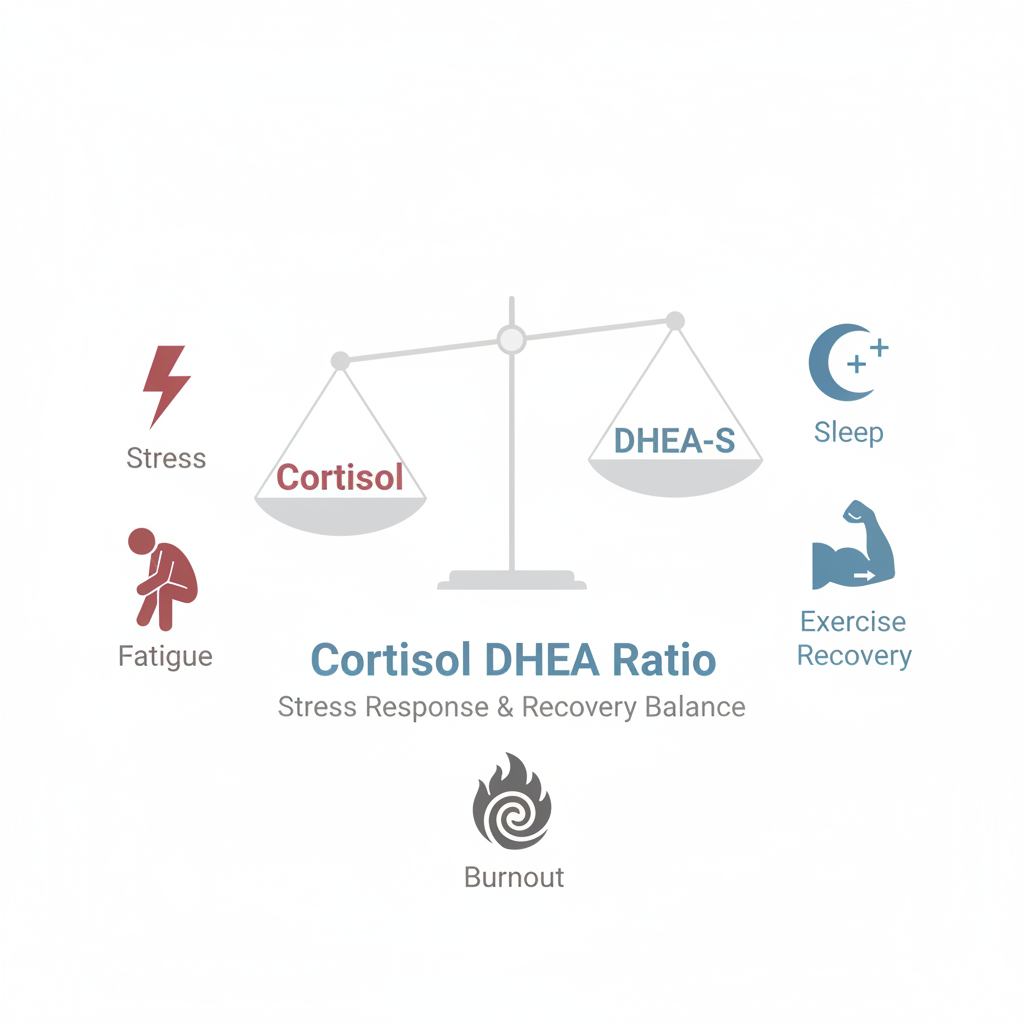
This is where the cortisol-DHEA ratio becomes interesting. Cortisol helps your body respond to pressure and demand. DHEA-S gives context around recovery, resilience and longer-term stress adaptation. Looking at cortisol alone can be useful, but the balance between cortisol and DHEA-S may tell a more complete story.
For people who feel “tired but wired,” struggle with poor workout recovery, wake during the night, crave sugar or salt, feel puffy under stress or seem to crash after busy periods, this ratio can help show whether the body is leaning more toward stress activation than recovery support.
What is the cortisol-DHEA ratio?
The cortisol-DHEA ratio compares cortisol with DHEA-S, the more stable form of DHEA commonly measured in testing. These two hormones are connected to the body’s stress-response system, but they represent different sides of the picture.
Cortisol helps mobilize energy. It supports alertness, helps maintain blood sugar during stress, affects inflammation and helps you handle physical or psychological demands. Cortisol is not bad. You need it to wake up, focus, exercise and respond to daily challenges.
DHEA-S provides context around recovery and resilience. It is often discussed as a counterbalance to cortisol because it is linked to repair, immune balance and longer-term adaptation to stress.
A simple way to think about it is this: cortisol shows how strongly your body is responding to stress, while DHEA-S helps show whether there is enough recovery support behind that response.
Why cortisol alone does not tell the full story
Many people talk about “high cortisol” as if it explains everything. In reality, cortisol is more about rhythm and context than one isolated number.
Cortisol is normally higher in the morning and lower in the evening. That morning rise helps you wake up and feel alert. A gradual decline later in the day helps the body move toward rest, sleep and recovery.
The issue is not simply having cortisol. The issue is when cortisol is high at the wrong time, stays elevated for too long, or is high compared with DHEA-S. In that situation, the body may be spending more energy on staying activated than on repairing, sleeping deeply and recovering well.
This is why the ratio matters. Two people can have similar cortisol results but very different DHEA-S levels. The person with lower DHEA-S relative to cortisol may show a more stress-dominant pattern, even if cortisol alone does not look extreme.
How stress can affect recovery
Stress is not only emotional. Hard training, poor sleep, under-eating, blood sugar swings, inflammation, deadlines, relationship stress and constant mental pressure can all activate the same stress-response system.
In the short term, this system is useful. It helps you perform, stay alert and push through. But if the body stays in that state for too long, recovery can become less efficient.
For someone who trains, this may feel like slower muscle recovery, worse performance, higher soreness, disrupted sleep or feeling like workouts suddenly “take more” from the body. For someone under work or life stress, it may feel like afternoon crashes, light sleep, low libido, brain fog, cravings or feeling wired at night but exhausted in the morning.
Some people also notice puffiness, fluid shifts or easier abdominal weight gain during stressful periods. These symptoms can have many causes, but stress hormone patterns may be one part of the wider picture.
What a high cortisol-DHEA ratio may suggest
A higher cortisol-DHEA ratio may suggest a more stress-dominant pattern, where cortisol activity is high relative to DHEA-S. This does not diagnose burnout or adrenal disease on its own, but it can provide useful context when symptoms point toward poor stress tolerance or reduced recovery.
This pattern may be relevant if you feel like your body is constantly “on,” but not truly recovering. You may sleep but not wake refreshed, rest but still feel drained, or train but struggle to bounce back.
Common symptoms that may fit this pattern include persistent fatigue, poor sleep, afternoon crashes, feeling tired but wired, brain fog, cravings, low libido, reduced stress tolerance and slower recovery after exercise.
These symptoms are not specific to cortisol or DHEA-S. They can also relate to thyroid function, iron status, blood sugar regulation, inflammation, nutrient levels, mental stress or sleep quality. The value of testing is that it helps show whether stress hormone balance may be part of the picture.
Why cortisol rhythm matters
Cortisol changes throughout the day, so one single measurement may not show the full pattern. Morning cortisol, afternoon cortisol and evening cortisol can tell different stories.
For example, someone may have normal morning cortisol but elevated evening cortisol, which may fit with feeling alert at night or struggling to wind down. Another person may have a flatter pattern, where cortisol does not rise strongly in the morning, which may fit with low morning energy or burnout-like fatigue.
This is why rhythm-based testing can be useful. The 4-Point Cortisol Test can help show how cortisol changes across the day. The Diurnal Cortisol & CAR Test gives a more detailed view, including the cortisol awakening response, which reflects how cortisol rises after waking.
If your main question is daily cortisol rhythm, these tests may be more relevant than a single morning sample. The Cortisol Single Test can provide a simple morning snapshot, but it does not show the full daily rhythm or the cortisol-DHEA ratio on its own.
How to test your cortisol DHEA ratio
To understand the cortisol-DHEA ratio, you need a test that measures both cortisol and DHEA-S. Cortisol gives insight into stress-response activity, while DHEA-S adds context around recovery, resilience and longer-term stress adaptation.
The Adrenal Stress Test – Cortisol & DHEA-S is the most relevant option for this article because it includes the two key markers needed to assess the ratio. This can be useful if you feel exhausted despite rest, struggle to recover from training, wake during the night, feel wired in the evening or notice that stress affects your body more than it used to.
If your symptoms overlap with broader hormone-related patterns, the Adrenal Stress Test Plus – Cortisol, DHEA-S & Prolactin may provide additional context. Prolactin can be relevant when stress-related symptoms appear alongside changes in libido, reproductive hormone patterns or other hormone-related symptoms.
Can you improve the cortisol-DHEA ratio?
The right strategy depends on your actual pattern. Someone with high evening cortisol may need a different approach than someone with low morning cortisol or low DHEA-S. This is why guessing can be unhelpful.
In general, the foundations are consistent sleep timing, enough food, stable blood sugar, recovery days, stress pacing and avoiding overtraining. For people who train hard, this may mean reducing intensity for a period, adding true rest days or eating enough protein and carbohydrates to support recovery.
For people under chronic stress, the focus may be different. Instead of pushing harder, the body may need predictable routines, better sleep boundaries, nervous system recovery and fewer repeated stress spikes throughout the day.
Supplements should be approached carefully. DHEA can convert into other hormones, including testosterone and estrogen, so it should not be taken casually without knowing baseline levels. Trying to “lower cortisol” without understanding your pattern may also backfire if cortisol is already low at certain times of day.
When should you consider testing?
Testing may be useful if you have persistent fatigue, poor stress tolerance, poor workout recovery, sleep disruption, afternoon energy crashes, brain fog, cravings, low libido or burnout-like symptoms that do not improve with basic lifestyle changes.
It may also be relevant if you feel stuck in a stress state: wired at night, tired in the morning, easily overwhelmed, slower to recover or more reactive to caffeine, intense training, skipped meals or poor sleep.
A cortisol-DHEA ratio does not explain everything, but it can provide a valuable piece of the puzzle when standard testing does not give clear answers.
Conclusion
The cortisol-DHEA ratio gives insight into the balance between stress response and recovery support. Cortisol helps the body mobilize energy and respond to stress, while DHEA-S provides context around resilience, repair and longer-term adaptation.
A higher ratio may suggest that the body is operating in a more stress-dominant pattern, which can be relevant for fatigue, poor recovery, burnout symptoms, sleep disruption, cravings and reduced stress tolerance. Interpreted alongside symptoms and other health markers, the cortisol-DHEA ratio can help turn vague stress-related symptoms into clearer information.
Disclaimer: This article is for educational purposes only and does not constitute medical advice. Always consult with a healthcare professional before making changes to your health regimen.